
“There’s never been a greater need for effective leadership at scale.”
This observation from the Center for Creative Leadership captures a challenge many organisations are grappling with right now. Complexity is increasing, change is relentless, and traditional leadership development approaches are often too slow, too individualised, or too disconnected from day-to-day behaviour to keep up.
The highest-performing organisations understand something critical: leadership development isn’t a ‘nice to have’. When it is tightly aligned to business strategy and delivered across the enterprise, it becomes a genuine source of competitive advantage. It drives organisational alignment, increases readiness for change, and strengthens leadership pipelines at every level.
This is where equine assisted learning — and in particular TeachingHorse’s The Diamond Model of Shared Leadership™ — offers a powerful and scalable solution.
Why Equine Assisted Learning Works at an Organisational Level
Equine assisted learning is not about horses as metaphors. It’s about behaviour.
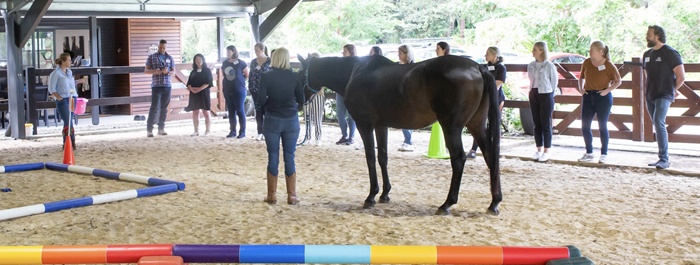
Horses are highly attuned to clarity, consistency, intention, and trust. They respond immediately to what people do, not what they say. This creates a learning environment where leaders and teams receive real-time, unfiltered feedback on how they communicate, influence, adapt, and align with others.
At scale, this matters. Organisations don’t fail because of poor strategy; they struggle because behaviour across the system is misaligned. Equine-assisted learning makes those invisible patterns visible — quickly and safely — and allows groups to experiment with new ways of leading together.
The Diamond Model™: A Shared Language for Leadership
TeachingHorse founder, June Gunter, developed The Diamond Model of Shared Leadership™ to address a common organisational gap: leadership is often taught as an individual capability, while work is increasingly delivered collectively.
The Diamond Model reframes leadership as a shared, dynamic process rather than a role or title. It provides a clear, practical framework that helps leaders understand how influence moves around a system depending on context, task, and capability.
Through experiential learning with horses, participants don’t just learn the model intellectually — they feel it in action. They experience when leadership needs to be directive, when it needs to be collaborative, when to step forward, and when to step back. This embodied understanding makes the learning stick and travel back into the workplace.
Creating Organisational Alignment
One of the strongest benefits of enterprise-wide equine assisted programs is alignment.
When multiple layers of an organisation experience the same framework and language — such as The Diamond Model™ — silos begin to soften. Leaders develop an understanding of what “shared leadership” looks like in practice, not just on paper.
Because horses respond to the group as a whole, teams quickly see the impact of mixed messages, competing agendas, or unclear direction. Alignment stops being a theoretical concept and becomes something participants can observe, adjust, and improve in the moment.
Enhancing Change Readiness
Change readiness isn’t about having a better change plan. It’s about how people respond under pressure.
Equine assisted learning places leaders in unfamiliar, uncertain situations where outcomes can’t be controlled through authority alone. This mirrors the reality of organisational change. Participants must regulate themselves, read the environment, adapt their approach, and collaborate effectively.
The Diamond Model™ supports this by helping leaders recognise which leadership approach is needed now, rather than defaulting to habit. Over time, this builds confidence, adaptability, and resilience — essential capabilities for organisations navigating ongoing transformation.
A Strategic Investment, Not a Novelty
When equine assisted learning is grounded in a robust framework like TeachingHorse’s The Diamond Model of Shared Leadership™, it becomes far more than a memorable experience. It becomes a strategic lever.
For organisations seeking alignment, adaptability, and leadership depth at scale, this approach offers something increasingly rare: learning that is human, practical, and transformative — and that genuinely supports business strategy.
If leadership is how strategy comes to life, then how we develop it has never mattered more.