
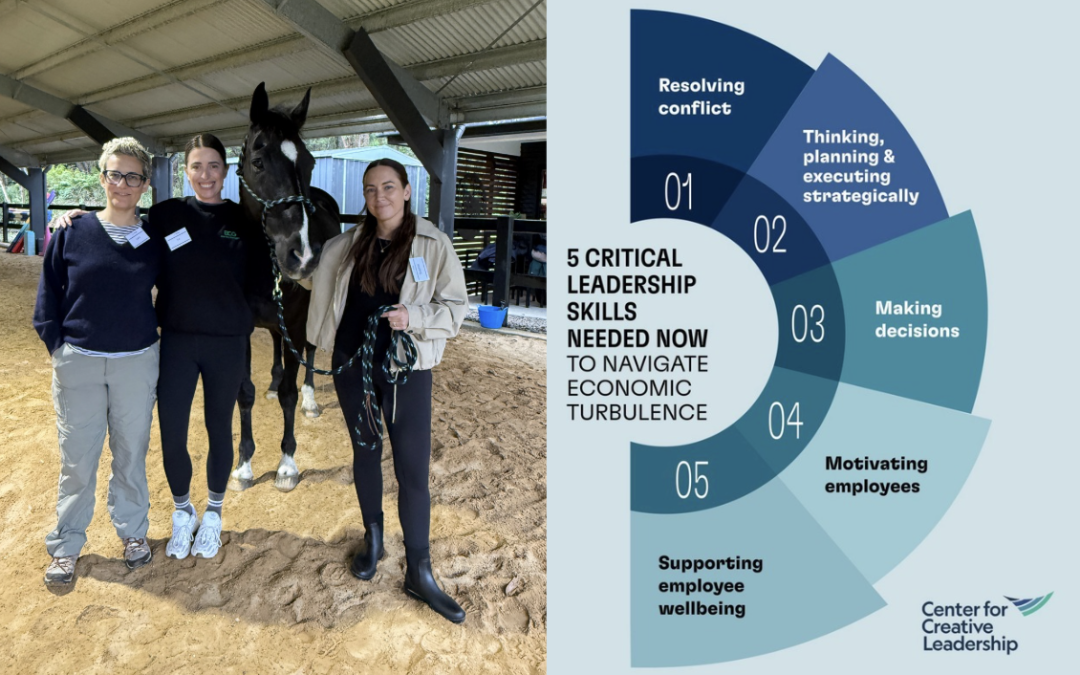
When uncertainty rises, leadership becomes personal. Pressure influences how we communicate, make decisions, respond to disagreement and support the people around us. Our intentions may be good, but what matters to others is how those intentions translate into behaviour.
Research from the Center for Creative Leadership (CCL) highlights five leadership skills organisations are prioritising to navigate economic turbulence: resolving conflict; thinking, planning and executing strategically; making decisions; motivating employees; and supporting employee wellbeing. These priorities emerged from a survey of 325 talent leaders and decision-makers. They reflect where organisations see a need to invest in leadership development.
For me, these priorities raise a practical question: how do we help leaders practise these skills when the situation is uncertain and their usual approaches are not working?
This is where equine enhanced leadership development can offer a valuable experiential approach. CCL’s research identifies development priorities – the connections with equine enhanced activities below describe how we can put those priorities into practice.
- Resolving conflict
Under pressure, differences can quickly become disagreements. We may push harder, withdraw, avoid a difficult conversation or assume someone else is being deliberately uncooperative.
Working alongside a horse creates an opportunity to notice these responses as they happen.
If a horse stops during an activity, what do we do? Increase the pressure? Become frustrated? Give up?
Or pause, observe and explore what might need to change?
The starting point is observation without interpretation. “The horse stopped” is an observation. “The horse is disrespecting me” is a story. A horse’s response can have many explanations, including its surroundings, previous learning and physical comfort.
With skilled facilitation, this distinction opens a useful leadership conversation: When someone responds differently from how I expected, how quickly do I make assumptions?
Participants can practise communicating clearly, respecting boundaries and adjusting their approach while remaining connected. These are valuable behaviours to bring into difficult workplace conversations.
- Thinking, planning and executing strategically
A plan can look excellent until it meets reality.
In an equine enhanced activity, a group might agree on a route through an arena, allocate responsibilities and begin with confidence. Then something changes and the horse responds. The horse may stop and refuse to move with the team, or he/she may change direction and take the lead.
The learning lies in how the group responds.
Do they remain focused on the purpose? Do they communicate clearly? Notice changes in the environment? Listen to someone who has spotted a problem? Adapt their plan together?
This provides a practical opportunity to explore the relationship between strategy and execution. Participants can see how individual actions support- or disrupt – a shared direction.
The workplace connection is clear: effective execution requires people to keep observing, communicating and coordinating as circumstances change.
- Making decisions
Uncertainty can pull leaders towards two extremes: acting too quickly to relieve discomfort, or waiting for a level of certainty that may never arrive.
An unfamiliar task with a horse can bring both tendencies into view.
Participants can practise pausing long enough to gather relevant information, choosing an appropriate next step, and observing what happens. They can then adjust course rather than becoming attached to their original decision.
Facilitated reflection helps distinguish evidence from assumption: What did I notice? What did I decide it meant? What other possibilities were there?
This creates a useful rehearsal for workplace decisions where information is incomplete. The aim is to develop a curious and thoughtful process for acting, reviewing and learning.
- Motivating employees
Leaders may believe they are offering encouragement while their team experiences urgency, confusion or pressure.
Working with horses gives participants an opportunity to explore the difference between their intended message and their observable behaviour, thereby building trust.
For example, someone may believe they are providing a calm, cooperative interaction while actually moving quickly, holding tension and repeatedly changing their cues and micromanaging the situation. Slowing down and becoming more consistent creates a different interaction to observe and discuss.
The horse is an individual with their own needs and motivations. The leadership learning comes from examining our contribution to the interaction.
Am I making the direction clear? Am I allowing time for a response? Am I noticing the effect of my approach? Am I using appropriate energy for the situation?
These questions help leaders consider how they create the conditions for willing participation, shared effort , trust and accountability.
- Supporting employee wellbeing
During turbulent periods, leaders can become so focused on delivery that they overlook the strain they and others are carrying.
An equine enhanced leadership session offers space to notice patterns that are easily missed in a busy working day: constant activity, difficulty pausing, reluctance to ask for help, or a tendency to put everyone else first.
Participants can explore what happens when they take a breath, establish a boundary, share responsibility or allow time to regroup.
The horses’ welfare belongs at the centre of this process too. Respecting their needs, choices and opportunities to disengage makes care and responsibility part of the learning itself.
Horses also model self-care beautifully. In a horse herd, the ultimate goal is the “health, harmony and unity” (June Gunter, TeachingHorse) of the entire group and each member works to achieve this through prioritising needs such as rest, resources and safety.
For leaders, the reflection extends beyond personal coping: What needs to change in the way work is organised, expectations are communicated and support is offered?
The value of equine enhanced leadership development lies in the opportunity to experience our behaviour, reflect on its impact and practise a different response.
That learning becomes useful when we take it back to our workplace: a difficult conversation approached with curiosity, a decision reviewed against evidence, a clearer shared direction, or an honest discussion about workload.
At Leading Edge Professional Development, we describe this as making the invisible visible.
Turbulence asks a great deal of leaders. Working thoughtfully with horses can create space to notice how we meet that challenge – and make more conscious choices about how we lead ourselves and others.